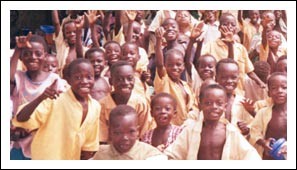
THE EDUCATION SECTOR IN GHANA The education sector in Ghana has seen tremendous growth with the intervention of the capitation grant and the school feeding program by the Ghana government and also private sector participation. the education system in Ghana was changed in September 2007 with the introduction of fifteen years of Basic education, four years of senior high school education and opportunities to enter into training colleges and tertiary institutions. BASIC EDUCATION Basic education is supposed to be free and compulsory for all Ghanaian children of school going age. However this very important constitutional requirement is not being met due to constraints in teaching facilities and well trained teachers. Children begin their years of basic education at the age of six, with six years of primary school and three years of Junior High School. This prepares them with the requisite knowledge in technical skills and the sciences. Students are required to take a basic education certificate examination which would enable them gain admission into any of the Senior High Schools, technical or vocational institutions SENIOR HIGH SCHOOL Senior High School education is intended to prepare students for university education. Students usually study courses in the Sciences, General Arts, Fine Arts, Business, Agricultural Science and Home Economics. Students are required to study a combination of three or four elective subjects and a number of core subjects usually four i.e. Mathematics, English, Integrated Science, and Social Studies. With this combination it means a student studying Science as his elective could study Biology, Physics, Chemistry and Additional Mathematics in addition to the core subjects mentioned above. A student offering arts as an elective could be studying Literature, Economics and Geography in addition to the core subjects mentioned earlier. Students sit for a certificate examination with the West African Examinations Council (WAEC) at the end of their study. WAEC organizes examinations for all secondary schools in five English speaking countries in West Africa; Ghana, Liberia, Sierra Leone, Nigeria and the Guinea. students who obtain aggregate 18 or better (usually the best six grades) can gain admission into a university. TERTIARY EDUCATION Ghana has seven (7) public universities, over twenty one (21) public training colleges, ten (10) Polytechnics one in each region of Ghana and other professional institutions such as the Ghana Institute of Journalism (GIJ), Ghana Institute of Management and Professional Administration (GIMPA), Institute of Professional Studies (IPS) etc. there are other private institutions also offering degree and diploma programmes. The seven public universities are: |